Riga (Latvia)
The SUPERSHINE Latvian lighthouse district is located in Āgenskalna priedes, in the Āgenskalns neighbourhood of Riga (population 595,053). The district includes 24 Soviet-era multi-apartment buildings (1959–1961) and one new NZEB building (2020), comprising 1,283 apartments housing around 2,700 residents. It has been designated by the municipality as a renovation wave pilot area within the Sustainable Development Programme 2021–2027.
Riga’s residential building stock is largely outdated and characterised by poor technical conditions, high heat losses, and elevated heating and maintenance costs. Despite the clear need for renovation, progress has been slow due to high upfront costs, limited resident engagement, uncertainty about long-term benefits, and persistent misconceptions about energy renovation. In this context, SUPERSHINE promoted a district-level (quarter) renovation approach, addressing multiple buildings and shared public spaces as an integrated system rather than through isolated, building-by-building interventions.
The project focused on improving energy efficiency and the quality of the living environment at neighbourhood scale, while placing resident engagement at the core of the process. A wide-ranging participation programme was implemented, including quarter-level community events, co-creation workshops, masterclasses, and information campaigns on energy retrofits and financing opportunities.
A key innovation of the Riga lighthouse was the adoption of a digital, democratic participation approach, designed to ensure equal and inclusive involvement. Online surveys, a dedicated digital platform, visualisations of residents’ needs, and anonymous voting mechanisms enabled broad participation, reduced social pressure, and helped avoid the dominance of a “loud minority”. This approach made it possible to collect representative, reliable input and translate it into concrete priorities.
Through the co-creation process, residents and experts jointly developed a shared vision for the quarter, supported by an action plan and a financing strategy for the renovation of buildings and public spaces. The Āgenskalna priedes pilot demonstrates how comprehensive, neighbourhood-based renovation can reduce energy consumption, improve comfort and liveability, and foster social inclusion, while strengthening community ownership and enabling long-term, sustainable change.
Financial Graphs

This figure shows that the full renovation package delivers the strongest financial performance in Riga under the shared savings model. When all interventions are combined, the return on investment reaches 12.63% for affordable housing and 12.59% for the ESCO, both far above the 6.11% benchmark represented by the S&P 500. Among the individual measures, wall renovation performs best, with returns of 9.88% for affordable housing and 11.36% for the ESCO, followed by floor and roof measures. Windows generate the weakest returns, at 3.44% for affordable housing and 6.71% for the ESCO. Overall, the chart highlights that bundling all measures together creates the most attractive and balanced investment case.
Energy Poverty Graphs
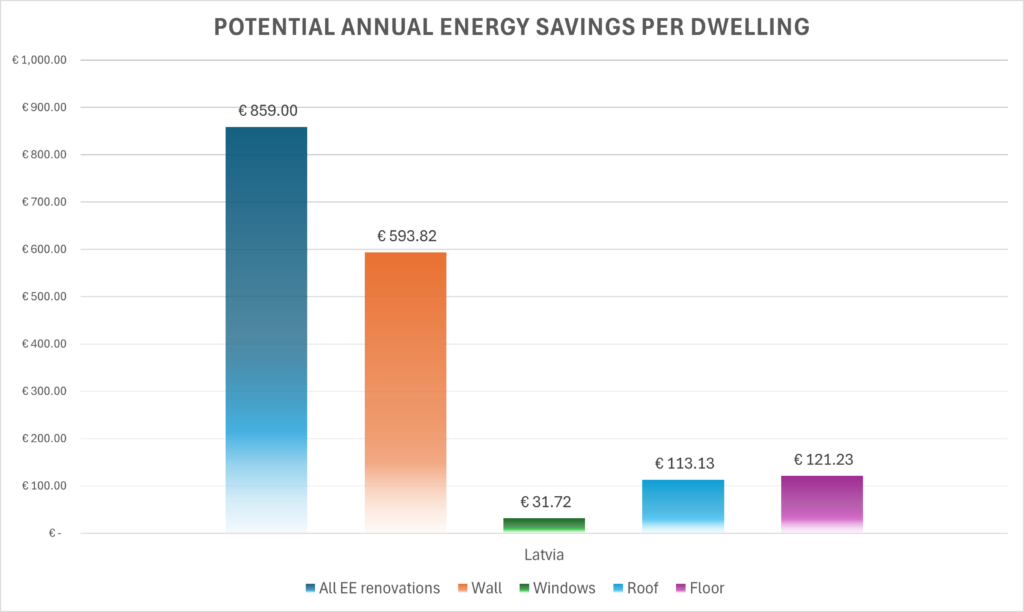
This chart shows that the largest annual financial benefit for households in Riga comes from carrying out the full renovation package, which is estimated to save €859.00 per dwelling per year. Looking at single measures, wall insulation delivers by far the greatest share of these savings at €593.82, while floor and roof interventions provide more moderate benefits of €121.23 and €113.13 respectively. Window upgrades contribute the smallest annual saving, at €31.72 per dwelling. The figure makes clear that while individual measures can help, the biggest impact for residents comes from an integrated renovation approach.

This figure illustrates a major improvement in affordability after renovation. Before the energy efficiency measures, households in the Latvian case were estimated to spend 48.55% of income on energy, indicating a very high energy burden. After renovation, this share falls to 17.77%, a reduction of more than 30 percentage points. In practical terms, the chart shows how deep renovation can significantly reduce financial pressure on low-income households and make energy costs much more manageable.

This chart shows a strong reduction in energy use intensity after renovation in the Riga case. Energy consumption drops from 514.00 kWh/sqm before renovation to 188.31 kWh/sqm after renovation, meaning that the building uses far less energy to provide the same level of service and comfort. This large reduction reflects the impact of upgrading the building envelope and improving overall efficiency. It also reinforces the financial findings, since lower energy demand directly supports lower bills for residents.
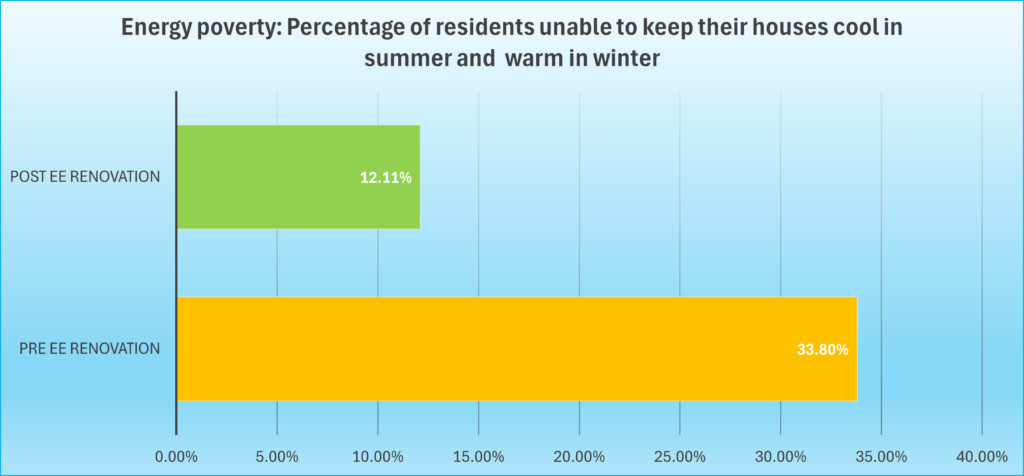
This figure highlights the social impact of renovation on household comfort. Before the works, 33.80% of residents were unable to keep their homes adequately cool in summer and warm in winter. After renovation, this share drops to 12.11%. The result shows that energy renovation does not only improve efficiency and reduce costs, but also has a direct effect on quality of life by helping more residents live in healthy and comfortable indoor conditions.
Lighthouses
Lighthouse districts are in three cities: Trieste (Italy), Herning (Denmark) and Riga (Latvia).