
SUPERSHINE hosted it’s Toolkit Workshop on 14 January 2026, bringing together project partners and external stakeholders for a focused capacity-building session on practical solutions to renovate social housing, reduce energy consumption, and tackle energy poverty.
The workshop showcased key approaches and lessons learned from our Lighthouse Districts and Fellow Cities, offering participants a structured overview of environmental, technical, and financial pathways that can support equitable and scalable renovation strategies across Europe.
The session highlighted Urban Green Infrastructure as a valuable support for energy savings and climate resilience, drawing on evidence from EU-funded projects demonstrating the potential of connected green networks such as green roofs, green corridors, community gardens, green façades/walls, and water elements. Our partners from DEMIR, underlined that UGI can contribute to cooling effects, flood prevention, improved environmental quality, and enhanced wellbeing, while noting that success depends on early planning, skilled implementation, and sustained long-term maintenance. Participants also explored practical recommendations and “what not to do” lessons especially the risks of treating UGI as purely decorative, or underestimating drainage and ongoing maintenance needs.

A second block focused on building envelope insulation and passive strategies to improve energy efficiency in existing building stock. Presentations covered key measures such as external insulation systems, window and door upgrades, roof improvements, shading elements, and façade solutions, alongside considerations for heritage and protected buildings. Speakers emphasised the importance of building audits, climate-appropriate material selection, and careful management of thermal bridges and condensation risks, as well as the need for monitoring and maintenance planning to ensure long-term performance.

Our partners from CIRCE, provided an overview of urban decarbonisation as a city-scale challenge requiring coordinated action across buildings, energy systems, and mobility. A stepwise framework was presented to support municipal decision-making from baseline diagnosis and target setting to techno-economic feasibility assessments, multi-criteria scoring, and implementation with a strong emphasis on tailoring measures to local contexts and relying on robust data.
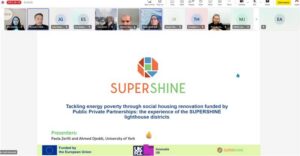
A central focus of the workshop was SUPERSHINE’s work on financial models for social and affordable housing renovation by Dr.Paola Zerilli and Ahmed Djeddi from University of York, designed to share investment risk and costs with external actors such as Energy Service Companies (ESCOs). The session presented how different contractual approaches (including shared savings and guaranteed savings models) can support renovation investment while improving energy poverty outcomes. Across Lighthouse Districts and Fellow Cities, analyses demonstrated how renovation scenarios can reduce energy demand and improve key energy poverty indicators, such as household energy expenditure relative to income and the ability to maintain comfortable indoor temperatures.
The workshop featured interactive quiz moments that helped participants consolidate key takeaways, ranging from UGI benefits and acceptance drivers to practical priorities for envelope refurbishment and implementation challenges.
Watch the full recording of our workshop here!
Cover photo credit: Manousos Kampanellis